The former primarily transfers text and graphic images, while the latter tends to transfer the entire product surface completely. Drape transfer technology uses a water-based film that dissolves easily in water to carry the image. Due to its excellent tension, the water-based film easily wraps around the product surface to form a graphic layer, creating a distinct appearance similar to spray paint. Drape transfer technology can be applied to workpieces of any shape, solving the problem of three-dimensional product printing for manufacturers. Curved surface draping can also add diverse textures such as leather, wood, jade, and marble, while avoiding the voids often seen in conventional flat printing. Furthermore, since the product surface does not come into contact with the printed film during the printing process, damage to the product surface and its integrity is minimized.
Water transfer printing uses a specially chemically treated film that is printed with the desired color and pattern. The film is then placed flat on the surface of water. The water pressure evenly transfers the color and pattern to the product surface. The overcoat automatically dissolves in the water. After cleaning and drying, a transparent protective coating is applied, giving the product a completely different visual effect.
02 Substrate and printing materials
① Water transfer printing substrate.
The water transfer printing substrate can be a plastic film or water transfer paper. Many products are difficult to print directly. You can use mature printing technology to print the image and text on the water transfer printing substrate first, and then transfer the image and text to the substrate.
Three-dimensional curved surface water coating film
Water-based overlays are printed on a water-soluble polyvinyl alcohol film using a traditional gravure printing process. Their high elasticity allows them to be easily wrapped around surfaces for three-dimensional transfer printing. However, their drawback is that the image and text can easily deform during the overlay process due to the substrate's high elasticity. Therefore, images are typically designed as continuous patterns to minimize distortion during transfer. Furthermore, gravure water-based overlays use water transfer inks. Compared to traditional inks, water transfer inks offer superior water resistance and dry by evaporation.
Watermark transfer paper
The substrate for watermark transfer paper is specialty paper. It must possess stable quality, precise dimensions, strong adaptability to the printing environment, minimal shrinkage, resistance to curling and deformation, ease of printing and color registration, uniform surface adhesive coating, and fast dehydration. Structurally, watermark transfer paper is not significantly different from water-coated transfer film, but the production process is significantly different. Generally speaking, watermark transfer paper is created by screen printing or offset printing onto the substrate surface. Using an inkjet printer is the most popular method. Using a printer and a computer makes it easier to create personalized images and text to your liking.
②Activator
The activator is an organic mixed solvent that can quickly dissolve and destroy the polyvinyl alcohol film, but will not damage the graphic printing layer. After the activator acts on the graphic printing layer, it can activate it and separate it from the polyvinyl alcohol film, thereby being adsorbed on the surface of the substrate to achieve water transfer coating.
③ Paint
Because the printed layer of the water-coated film has a low hardness and is easily scratched, the workpiece after water-coated transfer must be sprayed with a transparent coating to protect it, thereby further improving the decorative effect. The use of PV transparent varnish or UV light-curing transparent varnish can create a matte or mirror effect.
④Substrate materials
Water transfer printing is suitable for most materials we encounter in daily life, such as plastics, metals, glass, ceramics, and wood. Depending on whether a coating is required, the substrate material can be divided into the following two categories.
Materials that are easy to transfer (materials that do not require coating)
Some plastics, such as ABS, plexiglass, polycarbonate (PC), and PET, offer excellent printing properties and can be transferred without coating. This principle is similar to that of printing. Among plastics, PS is particularly challenging to print with through-the-water transfer printing because it is easily corroded by solvents and the active ingredients in activators can severely damage it, resulting in poor transfer results. However, the use of modified PS materials for water transfer printing should be considered.
Materials to be coated
Non-absorbent materials such as glass, metal, and ceramics, as well as non-polar materials like polyethylene and polypropylene, and certain polyvinyl chloride materials, require specialized coatings for transfer printing. Coatings are various types of paints that exhibit excellent adhesion to specialized materials and can be applied using methods such as screen printing, spraying, and roller coating. From a printing perspective, coating technology enables surface decoration on a wide range of printed materials. Many popular transfer processes, such as thermal sublimation, hot melt transfer, ceramic decal transfer, and pressure-sensitive transfer, all require coating technology for transfer printing onto these materials.
03 Printing Equipment
①Constant temperature transfer tank
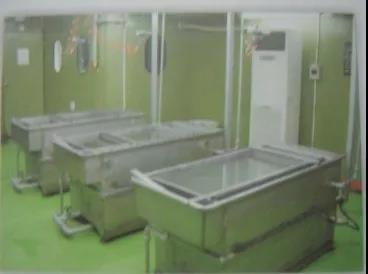
The constant temperature transfer tank is mainly used to activate the image and text on the water-coated transfer film and transfer the film to the product surface. The constant temperature transfer tank is actually a water tank with a constant temperature control function. Some are welded from tinplate, and some are made of stainless steel.
②Automatic film transfer equipment
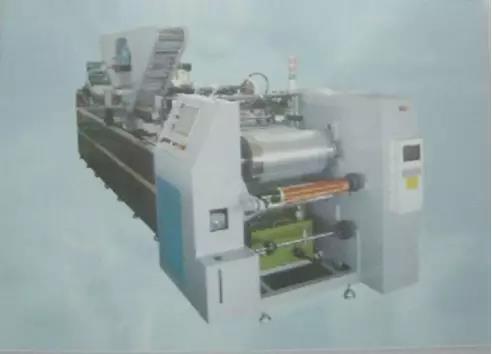
The automatic film transfer equipment automatically lays the water transfer film flat on the water surface in the transfer tank and automatically completes the shearing action. After absorbing water, the film forms a parallel state with the water and floats freely on the water surface. Due to the surface tension of the water, the ink layer is also evenly spread on the water surface. When the activator is evenly sprayed on the thin surface, the film will gradually break down and dissolve. Due to the water resistance of the ink, the ink layer begins to become free.
③Activator automatic spraying equipment
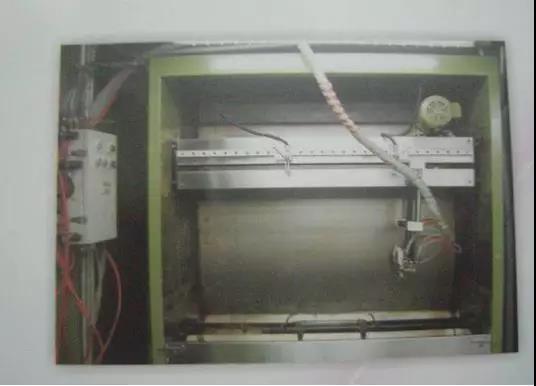
④Water washing equipment
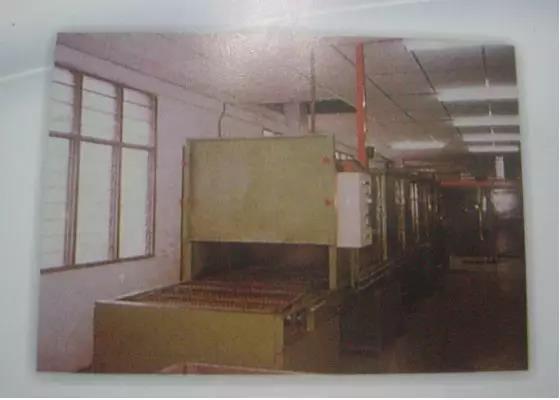 Washing equipment removes residual film from product surfaces. Typically, washing equipment is constructed as an assembly line to facilitate continuous production. It primarily consists of a water tank and a conveyor belt. After transfer, the product is placed on the conveyor belt, where operators manually clean any remaining residue before moving on to the next process.
Drying equipment is used to dry products after removing residual film and after oil spraying. Drying after washing is mainly done by evaporation of water, while drying after oil spraying is done by volatile solvent drying.
There are two types of drying equipment: production line type and single cabinet type. The assembly line drying equipment consists of a conveying device and a drying device. The main design requirement is that the product can be thoroughly dried after entering the drying unit and transported to the terminal. The drying device mainly uses infrared heating.
⑥ Primer and topcoat spraying equipment
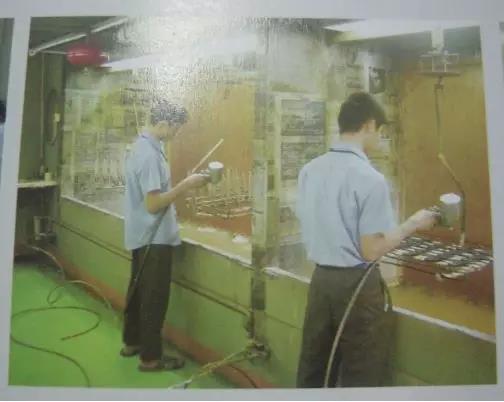
Primer and topcoat spraying equipment is used to spray on the product surface before and after transfer. It consists of a machine body and an oil spray pressure device. The oil used for spraying will turn into fine floating particles under extremely high pressure, forming adsorption force when it encounters the product.
04 Printing Technology
Water-coated transfer printing refers to decorating the entire surface of an object, covering the original appearance of the workpiece, and can print patterns on the entire surface of the object (three-dimensional).
Lay the water-coated transfer film flat on the surface of the transfer tank with the image layer facing up. Keep the water in the tank clean and essentially neutral. Spray the activator evenly on the image surface to activate the image layer and facilitate separation from the carrier film. The activator is an organic mixed solvent mainly composed of aromatic hydrocarbons that can quickly dissolve and destroy polyvinyl alcohol without damaging the image layer, leaving the image in a free state.
Water coating transfer process
Place the item to be water transfer printed onto the water transfer film, following its contours. The image layer will slowly transfer to the product surface under the action of water pressure. Adhesion is generated by the inherent adhesion between the ink layer and the substrate or special coating. During the transfer process, the substrate and the water transfer film must be placed at a uniform speed to avoid wrinkles on the film, which would affect the image. In principle, the image should be properly stretched and overlap should be minimized, especially at joints. Excessive overlap will create a cluttered appearance. More complex products require higher operational requirements.
Water temperatures that are too low may reduce the solubility of the substrate film; while water temperatures that are too high can easily damage the image and cause deformation. The transfer water tank can use an automatic temperature control device to maintain a stable water temperature. For large quantities of workpieces with simple, uniform shapes, dedicated water transfer equipment can be used instead of manual operation. For example, cylindrical workpieces can be fixed on a rotating shaft and rotated across the film surface to transfer the image layer.
Watermark printing is a process that completely transfers the image or text on the transfer paper to the substrate surface. It is very similar to the thermal transfer process, except that the transfer pressure relies on water pressure. It is a recently popular water transfer technology.
First, cut the graphic water transfer paper to be transferred into the required specifications, put it into a clean water tank, and soak it for about 20 seconds to separate the mask from the substrate and prepare for transfer.
Watermark transfer paper processing: Remove the watermark transfer paper and gently place it against the substrate. Use a scraper to press the image surface to squeeze out moisture, keeping the image flat and in place. Allow to air dry. For peelable watermark transfer paper, air dry and then place in an oven to improve adhesion. The drying temperature should be between 65-100°C. Because peelable watermark transfer paper has a protective varnish on the surface, no additional spray coating is required. However, soluble watermark transfer paper does not have a protective layer and requires a varnish coating after air drying. UV varnish should be cured in a curing machine. When spraying varnish, be sure to prevent dust from settling on the surface, as this will significantly affect the product's appearance. Coating thickness is controlled by adjusting the varnish viscosity and spraying amount. Overspraying can easily lead to a loss of uniformity. For substrates with larger transfer areas, screen printing can achieve a thicker coating and is also an effective protective measure.
05 Development Prospects
Water transfer printing uses water as a medium to transfer a design onto a substrate. While its production process and material costs are higher than those of conventional printing, and its procedures are more complex, it is a highly versatile printing method. This is not only because it can achieve effects unattainable by other printing processes, but more importantly, it is less demanding on the substrate's shape, allowing it to accommodate surfaces ranging from flat, curved, angular, and concave.
For example, it can handle everyday household items and decorative materials, overcoming the limitations imposed by other specialty printing methods on substrate shapes (large, small, irregular, etc.). Therefore, its application range is extremely broad. Regarding substrate materials, water transfer printing is suitable for smooth surfaces such as glass, ceramics, hardware, wood, plastic, leather, and marble. Water transfer printing does not require pressure or heating during the transfer process, making it the preferred process for ultra-thin materials that are sensitive to high temperatures and pressure.
②Unlimited market prospects Although there are many problems in the water transfer printing market, its market potential is huge.
With the continuous development of the economy, consumers have higher and higher requirements for product packaging, coating and grade. For the printing industry, the concept of printing is no longer the traditional paper printing in people's impression.
From daily necessities to office supplies, even home decoration and the automotive industry, more and better surface packaging is needed. Most of this packaging relies on transfer printing. Therefore, water transfer printing still has a long way to go, and its application range will continue to expand, with unlimited market prospects.
As for problems such as market chaos, small scale, low technical content and poor quality, it still requires unremitting efforts of industry insiders to catch up with the international market level.


